 Celebrating 40 years of excellence | Ranked among the world’s top 75 language service providers by CSA Research
Multilingual Workforce Communication: A Guide for HR Teams
Every October, Ana spends her lunch breaks explaining the benefits packet. She works in accounts payable, but because she’s bilingual, coworkers come to her desk with questions about deductibles, dependents, and deadlines. She’s glad to help. However, she’s not a benefits expert, and she isn’t always sure she’s getting it right.
The packet itself is clear, complete, and approved by Legal. It’s also only in English. Some of Ana’s coworkers read Spanish more comfortably. Some ask her for help. Some guess. A few set the packet aside and miss the deadline.
HR sees the missed enrollments and extra calls, but not the reason behind them. The packet went out on time and in full. What doesn’t show up in the numbers is the language gap, or the employee who has quietly become the organization’s unofficial benefits translator on top of her own job.
Versions of Ana’s story play out across sectors, from healthcare systems to financial firms to public agencies. When employees speak different languages, important information reaches some people later, or less clearly, than others.
How Do You Communicate with Employees Who Speak Different Languages?
Multilingual workforce communication is the practice of delivering workplace information, including policies, training, and benefits, in the languages your employees understand best. It combines translation of written materials, interpretation for live conversations, and multilingual video and eLearning. For HR teams, it works best as an ongoing program rather than a series of one-off requests.
This guide covers why it matters to your organization, which documents to translate first, when to translate them, and how to manage multilingual content as it changes.
Why Should HR Leaders Care About Multilingual Communication?
Employees who clearly understand workplace policies, instructions, and updates are safer, more engaged, and better able to contribute. Communicating in the languages your employees understand best helps your policies, benefits, and messages reach the full workforce they were written for. That clarity shapes three things HR leaders care about: the health of your teams, the quality of your decisions, and your organization’s results.
Most organizations don’t set out to build a multilingual workforce. They hire for skills and experience, and the languages come with the people. You may have employees who speak English well on the job but read a detailed policy or benefits guide more comfortably in another language. For HR, the question is whether the information you share reaches all your employees in a way they can understand and act on.
Safer, More Confident Teams
When employees can read their pay notices, leave policies, and safety procedures without struggling, they spend less energy decoding information and worrying about what they might have missed. That clarity reduces everyday stress and helps people feel more confident in their roles.
It also takes pressure off employees like Ana. Informal interpreting pulls bilingual colleagues away from their own work, and when the conversation involves discipline or medical leave, it raises privacy concerns for everyone involved.
Safety is part of team health, too. OSHA policy requires that safety training be delivered in a language and vocabulary employees can understand. When instructions are clear, people are less likely to get hurt.
Finally, language sends a signal. When an organization takes the time to communicate in an employee’s language, it tells that person they’re a full member of the team. For more on how cultural norms shape collaboration across diverse teams, see our article on cross-cultural communication.
Better Decision-Making
Leaders make better decisions when they hear from their whole workforce. Engagement surveys, safety reporting, ethics hotlines, and town hall Q&A sessions capture only the voices of employees who can participate comfortably.
Surveys are a clear example. An employee engagement survey offered only in English skews toward employees who read English most comfortably, so its results describe only part of your workforce. When employees can respond in their preferred language, more of them participate, and their answers tend to be more thoughtful, especially on open-ended questions. See our article on best practices for multilingual surveys.
Language matters even more for ethics hotlines. A hotline exists so leaders hear about misconduct, compliance issues, and safety risks, and can take action. Employees are more likely to report a concern, and to describe it clearly, when they can use the language they’re most comfortable in. Reports that arrive in other languages need fast, confidential translation so they reach the right people quickly.
Stronger Operational Results
Safer, more confident employees make informed decisions and deliver measurable results for your organization:
- Retention. Employees who feel informed and respected are more likely to stay, which lowers the cost of recruiting and onboarding replacements.
- Career growth. When employees fully understand career development opportunities, training programs, and promotion criteria, more of them pursue advancement, helping you fill roles from within.
- Fewer errors and incidents. Clear instructions reduce rework, quality issues, and workplace injuries.
- Reduced risk. When employees sign to acknowledge a policy they don’t fully understand, this documents receipt, not comprehension.
- Less strain on HR. Clear communication means fewer clarification calls, repeated explanations, and missed deadlines.
- Return on existing programs. Benefits, wellness, and training programs deliver value only when employees understand and use them.
Whether you’re translating for the first time or refining an existing approach, the sections below walk through the practical decisions.
Let's Chat
Communicating with a multilingual workforce? Let's talk through your content plan.
How Do You Know Which Languages to Support?
Start with the data you already have, then ask employees directly. Useful sources include:
- Language preference fields in your Human Resources Information System or onboarding forms.
- Voluntary employee surveys, offered in multiple languages, so you reach the people you’re trying to count.
- Input from supervisors, site managers, and employee resource groups.
- Location-level differences, since the languages spoken at one facility may differ from those at another.
As you finalize your list, confirm the specific form of the language each group needs, such as Simplified or Traditional Chinese. For guidance, see our article on choosing which languages to translate.
Which HR Documents Should You Translate First?
Start with what the law requires and prioritize content that affects an employee’s safety, pay, rights, and ability to meet a deadline. From there, a tiered approach helps you sequence the rest:
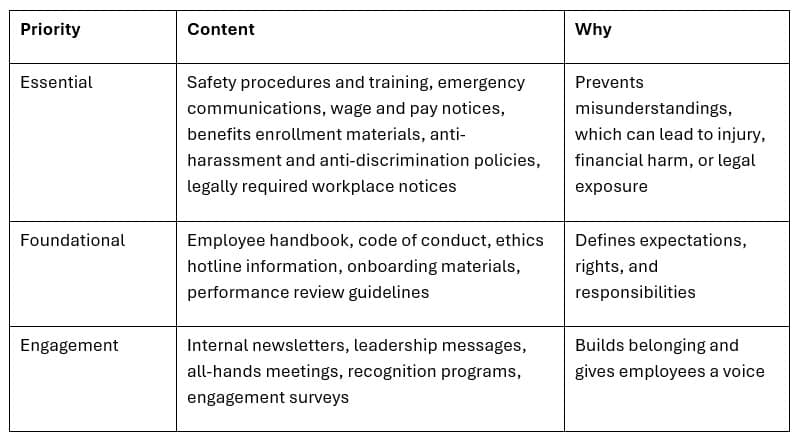
Within each tier, prioritize content by risk and by how directly it affects what an employee needs to do. A safety update that changes a daily procedure outranks a policy revision that affects only a few people.
Requirements vary by industry, location, and funding source. Some states require employers to post labor law notices or provide workplace documents in languages other than English, based on an employee’s primary language or on the share of the workforce that speaks a given language. Organizations that receive federal funding may have additional obligations. Review your requirements with legal counsel as you set priorities.
When Should Translation Happen?
Ideally, translated versions reach employees at the same time as the English version. When one group receives information days or weeks later, they have less time to act, and the delay itself can feel like a message about who matters.
Build translation into your content calendar around these milestones:
Onboarding: Onboarding materials should be translated in advance and kept current so that new hires receive them on their first day rather than weeks into the job.
Policy changes: Updates to pay, scheduling, leave, or conduct policies should reach every language group together.
Annual cycles: Open enrollment, performance reviews, and compliance training renewals arrive on predictable dates, so plan ahead.
Urgent communications: Emergency procedures, safety alerts, and operational disruptions can arise without warning. Talk with your language partner upfront about expected turnaround times and rapid-response options so that you know what’s possible when timing matters.
How Should You Deliver Multilingual HR Content?
Translated documents are the foundation of multilingual HR communication. Other formats carry information that documents can’t, from live company meetings to training that’s easier to watch than read. The right mix depends on your workplace and the content.
- Training videos: Subtitles, voiceover, or both make training and leadership messages easier to follow. Choose formats based on employees’ preferences and where they’ll take the training. See Video Localization 101.
- eLearning courses: Translated text, localized audio, and adapted scenarios help required training feel relevant to each group of employees.
- Live interpretation: Interpreters at town halls, benefits information sessions, and in-person group trainings let employees follow along in real time.
- Accessible formats: Tagged PDFs, captions, large print, and sign language interpretation serve employees with disabilities. Planning accessibility alongside translation is simpler than retrofitting materials later. See our article on translation and accessibility.
Pairing formats often works best. A translated benefits guide combined with a short video and an interpreter at the enrollment session reaches more people than any one format alone.
How Do You Manage Multilingual HR Content Over Time?
HR content changes frequently. Policies are revised, benefits change each year, and training is updated. A clear system keeps every language version accurate and consistent as your content evolves:
- Start with clear source content. Plain, direct writing in English makes translation faster and more consistent across languages.
- Build a glossary. Agree on how to translate benefits terms, job titles, program names, and company-specific language so that employees see the same terms everywhere.
- Build on past translations. Take advantage of your language partner’s translation memory (TM), which stores approved, translated segments, so updates focus only on what changed. Over time, TM lowers costs and keeps terminology consistent.
- Keep one owner and one workflow. Route HR, communications, and training content through a single process so that updates don’t slip through the gaps between departments.
- Set up a structured review process. Assign one qualified reviewer per language, someone fluent in both languages and familiar with your organization. Reviewers focus on accuracy and terminology rather than style, and your language partner validates their changes. See our best practices for translation review.
- Track versions. Confirm that each language reflects current policy, and retire outdated versions when updates are distributed.
Over time, this system becomes an asset. Each assignment makes the next one faster, more consistent, and better aligned with your organization’s voice.
Bringing It Together
So, what happens to Ana next October?
This time, the open enrollment packet goes out in English and Spanish on the same day. A short video walks through the plan options in both languages, and an interpreter joins the benefits information session. Ana’s coworkers have what they need before the deadline, in the language they read best.
Ana eats lunch without interruption. When a coworker does stop by her desk, the question is different. It’s no longer about what the packet says. It’s about which plan they chose for their family, the kind of conversation any two colleagues might have.
HR notices the difference, too. More employees enroll on time, and fewer call afterward with questions. That’s the real measure of multilingual workforce communication: employees understand the information they receive, act on it with confidence, and feel that their organization is speaking to them. And people like Ana, who have been quietly filling the gap, can get back to their own work.
Frequently Asked Questions
Do we need to translate materials if our employees speak English at work?
Often, yes. Employees may communicate well in English day-to-day but understand detailed information, such as benefits options, policy changes, or safety procedures, more fully in their language. Everyday conversation and complex written material call for different levels of comprehension, and translation closes that gap.
What are the benefits of translating HR materials for employees?
Translating HR materials helps employees fully understand policies, benefits, and safety procedures, so they can act on them with confidence. Organizations benefit too: safer workplaces, more complete feedback from engagement surveys and ethics hotlines, fewer errors and missed deadlines, and stronger retention.
Are employers required to translate workplace documents?
Some requirements apply. OSHA requires that safety training be delivered in a language and vocabulary employees can understand, and some states require certain workplace notices in an employee’s primary language. Requirements vary by industry and location, so review your obligations with legal counsel.
Which HR documents should be translated first?
Start with content that affects safety, pay, benefits, and legal rights: safety procedures and training, wage notices, benefits enrollment materials, and anti-harassment policies. Then move to foundational documents like the employee handbook and code of conduct, followed by engagement content such as newsletters and leadership messages.
How do we keep translated HR content up to date?
Use a glossary for consistent terminology, translation memory to focus updates on what changed, a single workflow for all HR and internal content, and version tracking so that each language reflects the current policy. Release translated versions at the same time as the English version whenever possible.